You’ve finished your novel and are ready to take the next step towards publishing. Now what? Well, obviously, the manuscript needs a professional edit. But every editor’s website seems to offer a different combination of services. One of the most common questions I get from self-publishing authors is: What is the difference between line editing, copy editing, and proofreading?
The answer might not be as straightforward as you’d hope. One reason is that these services overlap in some areas, but also, individual editors define their scope differently. The key is to understand what type of editing your manuscript needs and what a particular editor includes. This is usually determined by a sample edit. More on that later.
Broadly speaking, we can establish that:
Line editing focuses on how your writing reads.
Copy editing focuses on correctness and consistency.
Proofreading checks the final, formatted book for remaining errors.
Let’s look at what each service actually involves.
What is line editing?
Line editing works at a sentence and paragraph level, focusing on the effectiveness of the writing and the overall style rather than whether it’s just technically correct. In fact, during this edit, you, the author, and your editor might consciously decide to ignore a grammar rule if it deepens the story's emotional impact (for example, sentence fragments in romance books).
A line editing round usually focuses on the following aspects of a manuscript:
Clarity: Is the meaning immediately understandable? Are there any confusing phrases or sentences that might pull the reader out of the story?
Flow and rhythm: Do sentences read smoothly? Does the pace correspond to the intensity of the scene? A good rule of thumb is to use shorter sentences in suspenseful, action-packed scenes and longer sentences in reflective scenes, where you want to slow the pace and let readers take a breath. Different genres also utilize different paces. For example, a murder mystery/suspense might require a faster pace, whereas a memoir is usually slow-paced, with longer, contemplative sentences.
Word choice: Are the words precise and appropriate?
Conciseness: Can unnecessary words be removed? Is Jane ‘really happy’ or is she ‘ecstatic’?
Repetition and redundancy: Are words, phrases, or ideas repeated unnecessarily? I often see authors (especially less experienced ones) over-explaining or repeating the same information. My advice to them is to trust their readers.
Awkward phrasing: Does a sentence sound clunky or unnatural? Overloaded descriptions, unnecessary wordiness, passive voice, awkward dialogue, and multi-focus action can make your reader do a double take and pull them out of the story. And pulling a reader out of the story is the biggest crime a writer can commit (aside from plagiarism, of course).
Voice and tone: Does the prose sound like the author and suit the scene/story/genre? A common concern authors have when working with an editor is that the editor will change their unique author’s voice and make it sound like someone else. A good editor knows how to improve a manuscript while preserving the writer’s voice.
Consider the following example:
She began to walk slowly toward the door, feeling a strange sense of nervousness creeping over her.
What’s wrong with this sentence? Well, nothing is technically wrong, but the sentence is clunky and diluted. To improve it, I might change it to something like:
She edged toward the door, unease creeping in.
This revision tightens the sentence and makes the movement more immediate. However, the best variation depends on the specific scene, character, and author’s intended voice. Line editing doesn’t aim to make every sentence shorter, but rather to convey information and create an emotional connection between the story and the reader.
Line editing comes after developmental/structural editing, meaning the story is finalized and no major plot revisions are expected after this phase.
What line editing doesn’t usually include is major plot revisions (as mentioned above), rewriting entire chapters, or fixing every technical detail as its primary focus. To be perfectly honest, I can’t resist fixing a comma during a line edit, but I won’t be actively searching for misplaced commas. Some editors (myself included) often combine line and copy editing as one service.
To summarize, line editing helps your writing communicate more effectively while preserving your voice.
What is copy editing?
Copy editing focuses on grammar, spelling, usage, and consistency throughout the manuscript. Sometimes, it might also involve fact-checking, depending on the agreed scope.
These are the main aspects copy editing covers:
Grammar, spelling, and punctuation
Correct word usage and sentence structure
Consistent spelling, capitalization, and hyphenation
Consistency in character names, ages, descriptions, and attributes
Timeline accuracy.
To ensure consistency throughout the manuscript, a copy editor usually creates a style sheet that includes general style and punctuation choices (for example, whether the Oxford comma is used or not), a list of words (for preferred spelling), characters, locations, and timeline. The style sheet serves as a bible documenting decisions and preferences. If the author has a particular preference about spelling or usage, it goes in the style sheet.
Consider the following sentence:
I could of sworn you were here yesterday.
I encounter this issue way more often than I’d like to admit.
The correct version is: I could’ve sworn you were here yesterday.
“Could’ve” is a contraction of “could have.” “Could of” is grammatically wrong.
Continuity issues are another common occurrence in the manuscripts I edit. In Chapter 1, Jane has blue eyes, but in Chapter 14, Max stares lovingly into her green eyes. Would AI catch this?
Copy editors usually fix errors right away (using Track Changes, so the author would know what has been changed), but sometimes, we may query an apparent inconsistency rather than make an assumption about the author’s intention.
Keep in mind that copy editing doesn’t include substantial stylistic rewriting or major developmental changes, although I can’t imagine not flagging a plot hole or other structural oversight that should be addressed.
The key takeaway about copy editing is that it makes your manuscript more accurate, consistent, and technically correct.
What is proofreading?
Proofreading is traditionally the final quality-control stage, performed on a formatted proof after editing and layout. It’s the final check before publication, combing for remaining errors and problems introduced during typesetting or formatting.
A proofreader will typically focus on:
Remaining typos and missing words
Punctuation or spelling errors that slipped through
Formatting inconsistencies
Missing or duplicated text
Chapter headings, page numbers, and running headers
Problems with spacing, page breaks, or layout.
If a character’s name is spelled correctly throughout the edited manuscript, but a typo appears in the designed book, or if a chapter heading is accidentally omitted during layout, a proofreader should catch that.
Many self-publishing authors use proofreading to mean a final check of a Word manuscript. Terminology may vary, so make sure to ask your editor exactly what the service covers. If the manuscript has not been through a thorough copy edit, a proofreading-only pass may not be enough.
Proofreading is the final safety net, not a substitute for a full edit.
Hopefully, by this point, you have a better idea of how line editing, copy editing, and proofreading differ. If concepts are still blurry, the table below might help give you a quick answer:
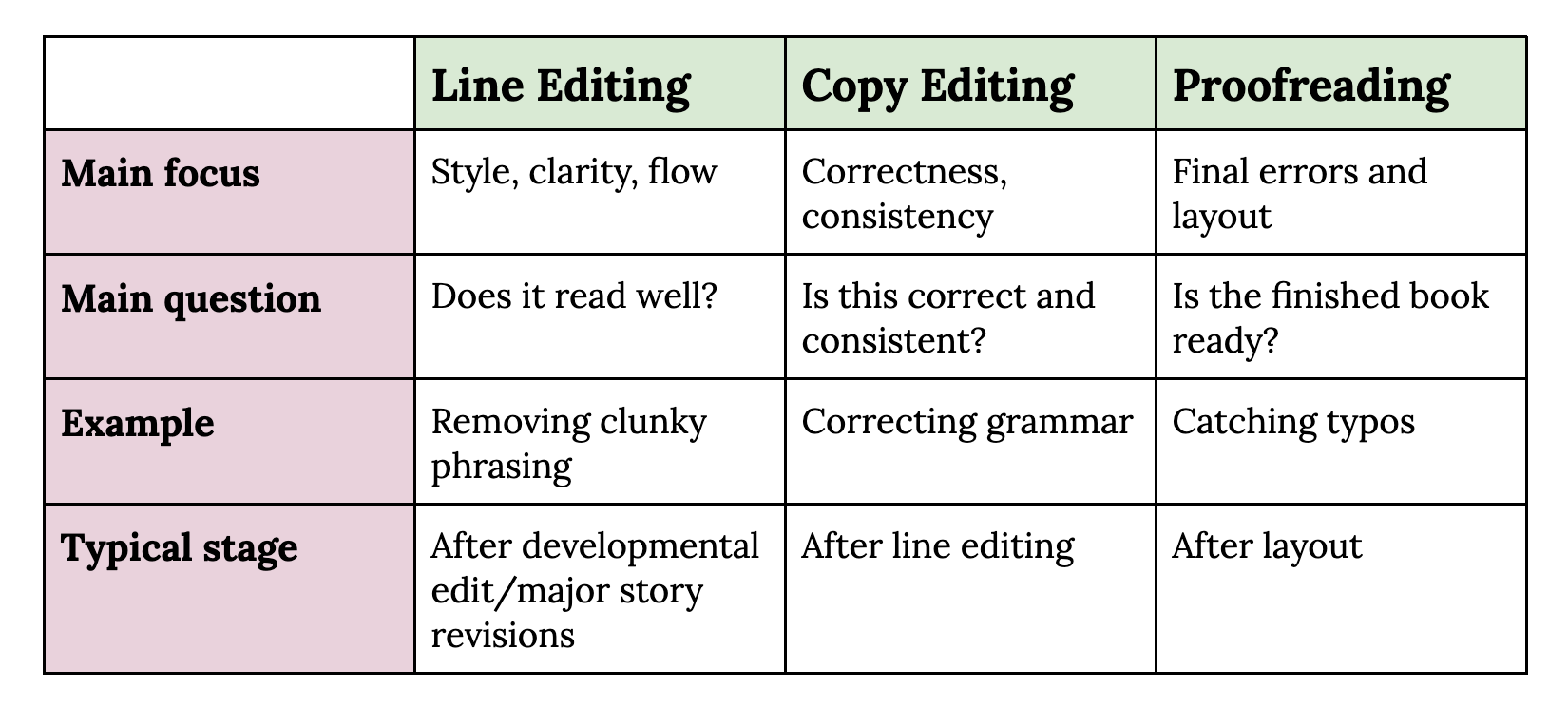
While each service type is distinct, they may sometimes overlap. For example, I sometimes combine line and copy editing when the manuscript allows. Always clarify the project scope with your editor rather than relying on labels alone.
Which type of edit does your novel need?
Deciding what kind of edit your manuscript needs can feel overwhelming, especially for less experienced authors. If this is your first book, here’s a quick, practical guide to help you decide what is the correct service for your manuscript:
Choose line editing if…
Your story is largely settled, but the prose feels clunky, repetitive, unclear, or inconsistent in tone.
Choose copy editing if…
You’re happy with the writing and story, but need a thorough check of grammar, punctuation, spelling, usage, and consistency.
Choose proofreading if…
Your manuscript has already been edited and is now in its final, formatted layout, ready for a last quality-control check.
Don’t put pressure on yourself to diagnose every issue alone. A good editor will always request a sample and discuss which service fits your manuscript and goals. The budget is often taken into consideration as well.
Do you need all three types of editing?
The typical sequence of services is developmental edit (if needed) → line edit (if needed) → copy edit → proofread.
However, not every manuscript needs a separate line edit. Some authors choose a combined service (line+copy edit), and some manuscripts need more extensive structural work before sentence-level editing makes sense.
Though each editing stage has its purpose and value, automatically purchasing every service available is unrealistic and, in some cases, unnecessary. Yes, skipping a service when the manuscript needs it can leave unresolved problems, but on the other hand, paying for multiple services with overlapping scopes can mean paying twice for similar work.
So, I hope I was able to bring some clarity and make your decision-making process a bit easier. The main takeaway I hope you remember from this article is this:
Line editing helps your writing read better.
Copy editing makes the text correct and consistent.
Proofreading catches remaining issues in the finished book.
Choosing an editing service doesn’t have to be complicated, and your manuscript doesn’t have to be perfect before you seek professional help.
Still not sure which type of editing is right for your novel? I offer a free sample edit so you can see how I approach your writing, what I’d focus on, and whether we’re a good fit.
Request your free sample edit.